
Why Everyone Stops Here
On ichiguu, and what a circular window at Meigetsuin taught me about the place you are already standing.

It was sunny when I arrived.
The hydrangeas at Meigetsuin were everything I had been told they would be. Blue deepening toward violet at the center, clusters pressed against each other along every path, a color that seems to absorb the June light rather than reflect it. The garden was full of people with cameras. The light was good. I walked the paths. I looked at the flowers. I photographed some of them.
Then I noticed a small crowd gathered ahead of me. Everyone was still, all facing the same direction. I walked toward it and stopped. The famous circular window.
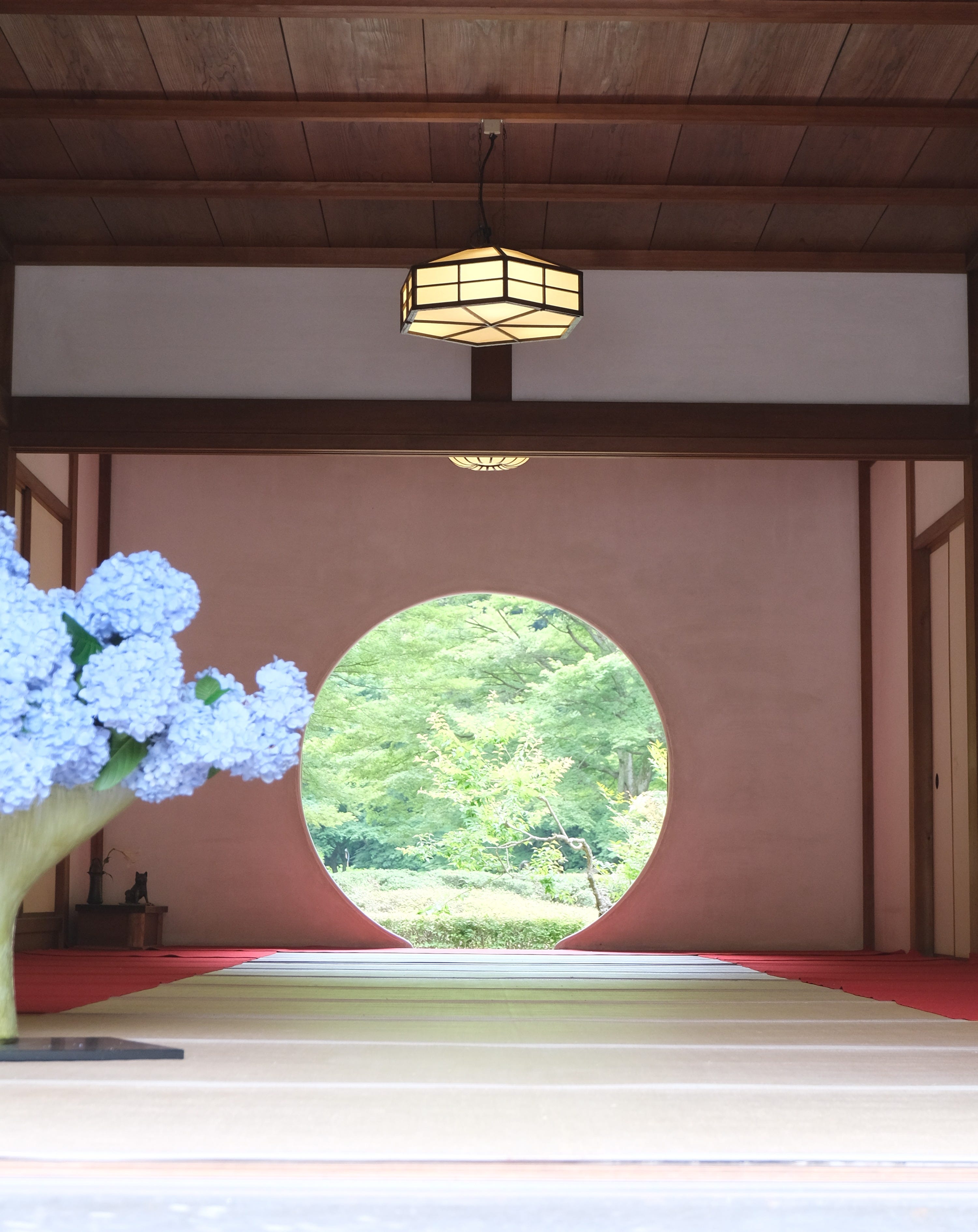
I had known it was here. Most people who visit Meigetsuin come partly for this: Satori no Mado, the Window of Awakening. It is cut directly into the wall of the main hall, a perfect circle about the height of a person. Through it: a single section of garden. A few clusters of hydrangea. A stone. Some moss. Nothing that was not also outside, in the larger garden I had just walked through.
I could not see most of the garden. The circle showed me one small section, framed it completely, and everything else was gone.
I stood there longer than I expected. The people around me were also standing still.
And I kept thinking: why? The whole garden was out there. We had just walked through it. We had seen more blue than the eye could hold, more hydrangeas than we could properly look at. And yet here we all were, stopped in front of a window that showed us less.
Ichiguu(一隅) is the Japanese word for one corner. One section. A small, specific portion of a larger whole.
There is a phrase built around it: ichiguu wo terasu(一隅を照らす).To illuminate one’s corner. The phrase is old. It is attributed to Saicho, the Buddhist monk who founded the Tendai school in ninth-century Japan. In his writings, he described the ideal student as someone who illuminates their own corner: who does not seek to be everywhere, but tends to the specific place they have been given, and tends to it completely.
The Window of Awakening was not built to illustrate this idea. Satori no Mado has its own history, its own intention. These are two different things.
But standing in front of it that morning, I could not help thinking of the phrase.
Because what the window does is simple: it removes the option to look at everything. There is only this corner. And because there is only this, you actually see it. Not the shape of a flower in general but the specific deepening of this blue, at this hour. Not moss as an idea but this particular patch, the way it holds the morning light. The circle does not impoverish what is inside it. It concentrates it.
A garden glimpsed through everything is still just a garden. A garden seen through a circle becomes something you remember.
There is something almost counterintuitive in this. We tend to think more information produces more understanding. More views, more angles, more access. But the people standing around me had already seen the whole garden. They had walked every path. They had seen far more than the window was showing them. And yet here they were, in front of the least, more present than they had been at any point along the way.
That is what I found myself understanding, not as an idea but as a feeling in my body, standing there with the crowd. Ichiguu wo terasu is not the instruction to be grand, or to be everywhere, or to do as much as possible. It is the opposite instruction. Find the corner that is yours, and light it completely. The window did not explain that to me. It showed me what it feels like.
The rain began just after noon.
I was still near Meigetsuin, walking slowly back toward the station. The change came the way June rain does in Kamakura: first a different quality in the air, then the sound of it, then it was simply raining.
And the hydrangeas changed.
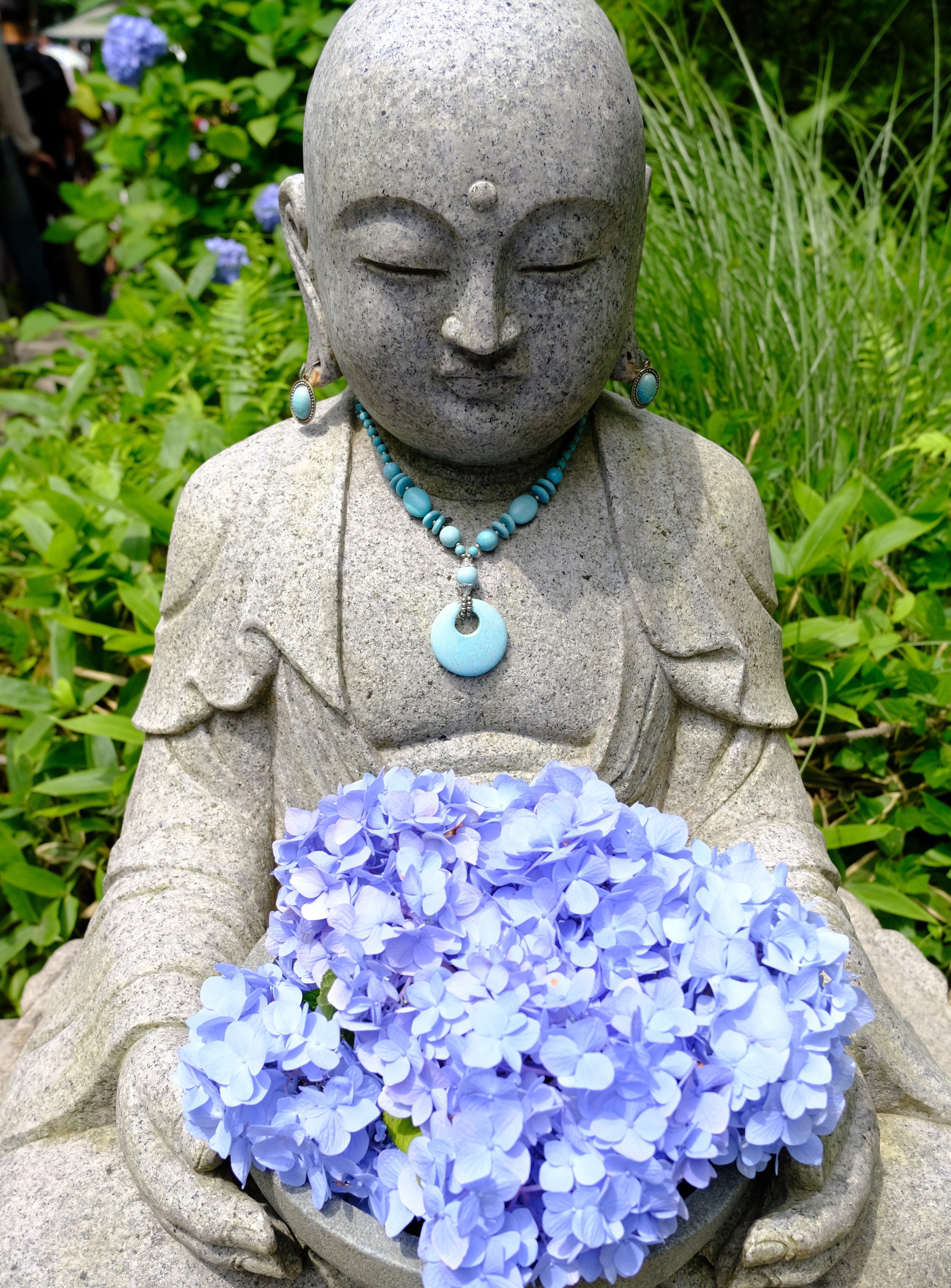
I had thought I understood what they looked like. I had photographed them in the morning. But in the rain they became something else. The blue deepened. Each petal held small pools of water that caught the grey light and did something with it. The color that had looked beautiful an hour earlier now looked true. As if the sunny morning had been a kind of waiting, and this was the moment the flower had been built for.
Ajisai, the Japanese word for hydrangea, are flowers of the rainy season. Not flowers that survive the rain, or that happen to bloom during it. Flowers of it. The rainy season is not the difficult condition they endure. It is the condition they were made for. They bloom where they were planted, in the season they were given, and in the rain that the season brings. They do not try to be cherry blossoms in April. They do not try to bloom on a sunny hillside. They are entirely, completely themselves in the corner they were placed in.
That is ichiguu wo terasu, in its quietest form. Not a declaration. Not a sacrifice. Just this: becoming entirely yourself in the place and season you were given.
There is a shadow worth naming.
The pressure of modern life runs the other way. Every platform suggests you should be in more corners. Every metric counts how far you have spread. The person who works in one place, quietly, without expanding, is not what visibility currently rewards.
I have felt this pressure too. Writing about one country, through one particular lens. The question that arrives sometimes, late at night: is one corner enough? Is this enough?
I thought about that standing in the rain outside Meigetsuin. Behind me, the famous window. In front of me, the hydrangeas doing what they do in rain. And around me, people still stopping. Still standing still in front of something small and complete.
The corner does not need to be large to stop people. It needs to be fully lit.
On the train back to Tokyo, still slightly damp, I thought about what I had been looking for when I decided to go to Kamakura.
Not the hydrangeas exactly. Not the famous garden, not the window whose full name I had looked up only afterward on my phone: Satori no Mado. Window of Awakening. I turned the name over in my mind. Awakening, I thought, not as enlightenment in the dramatic sense, but as something simpler. The moment you stop scanning and actually see.
Ichiguu is not a place you travel to find. It is not a window you have to seek out. It is wherever you are already standing, if you are willing to stop moving and look at what is there.
The whole garden is always out there. You can keep walking through it.
Or you can stop at the window. And see what the circle chose to show you. And stay there, in the rain, until you understand why you cannot leave.
Next: Japan has a word for obligation that does not feel like obligation. Because it was never supposed to. Next issue is on giri: the debt that connects, the duty that binds, and why the weight of it can feel, sometimes, like love.
I Kept Saying Sorry Abroad. I Was Never Apologizing.

At some point during my first months abroad, I noticed I was saying sorry constantly.
The Goodbye That Was Already in the Hello

I shared a taxi once in Myanmar with a woman I had never met and would never see again. We were both going roughly the same direction, which was enough. Her English was limited. My Burmese was worse. We spent forty minutes in the back of a small car, communicating through gestures, photographs on our phones, and laughter at the gaps between us.

The window showing you less so you finally see — I felt that in my body. I once stood before a landscape so beautiful I couldn't photograph it; trying to capture all of it meant capturing none of it. The circle understands what the wide view forgets: that we only really see what we're willing to leave most things out for. Beautiful!
Profound and gorgeous at the same time. Thank you for sharing this remarkable story.